Long Ago and Far Away
A curriculum by Dan Harper currently in development, v. 0.1
Copyright (c) 2026 Dan Harper
Moses in the Wilderness
Story in development.
Session plan: Moses in the Wilderness
Top-level educational goals:
(1) Have fun and build community;
(2) Increase “Biblical literacy”;
(3) Build skills associated with liberal religion, e.g., interpersonal skills, introspection, basic leadership, being in front of a group of people, etc.
Educational objectives for this session:
(1) Get to know other people in the class;
(2) Hear a story from the Hebrew Bible;
(3) Be able to talk about one or more incidents or themes from the story, e.g., if parents ask what happened in Sunday school today.
Preparation:
Coming soon.
I/ Opening
Take attendance.
Light chalice with these or other words: “We light this chalice to celebrate Unitarian Universalism: the church of the open mind, the helping hands, and the loving heart.”
Check-in: Go around circle. Each child and adult says their name, and then may say one good thing and one bad thing that has happened in the past week (anyone may pass).
II/ Read the story “Moses in the Wilderness”
Read “Moses in the Wilderness” out loud.
III/ Act out the story
We will help the children internalize the story by acting it out.
Ask: “Who are the characters in this story?”
Set up the stage area, and have the audience sit facing the stage area. The lead teacher reads the story, prompting actors. At appropriate moments in the story, you may want to prompt the children to think through the following things:
Coming soon.
IV/ Conversation about the story
Sit back down in a group. Now ask some general questions: “What was the best part of the story? Did the story make sense to you?” — or questions you come up with on your own.
Now some questions specific to the story.
Now open-ended questions about the moral of the story. Note that I’ve chosen Bible stories that are also great literature; and great literature resists easy interpretations.
V/ Play a card game or free play
Play the card game “Exodus.” In this card game, players try to see who can make it through the wilderness first. See description of the game below. The professionally produced 108-card deck in a cardboard storage box may by obtained from the curriculum author. Price as of 2025 is $30 (but please inquire for current price).
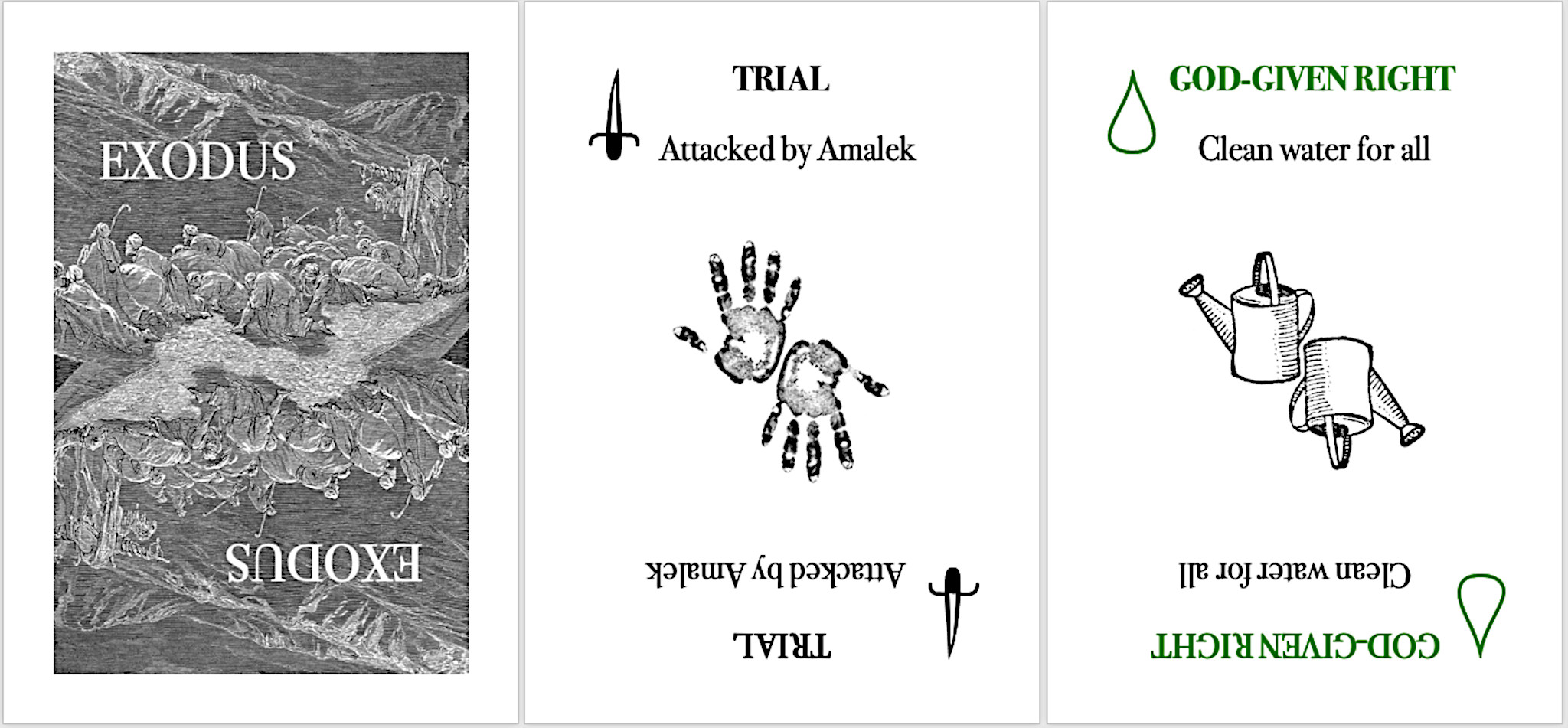
Exodus: The Card Game
Game copyright © 2018 Dan Harper
The story behind the game: “Exodus: The Card Game” gets its story from the Book of Exodus in the Bible. Each of the Trials in the game is one of the challenges that Moses and his followers had to face after they escaped from the Pharaoh in Egypt and journeyed through the wilderness to reach the Promised Land. Here are the challenges Moses and the Israelites faced, and the way their God helped them overcome each challenge (in the order they appear in the Bible):
1. As the Pharaoh’s army pursues them, the Red Sea blocks their escape (Ex. 14:9) — God parts the Red Sea, allowing Moses to get away (Ex. 15-16)
2. There’s no clean water to drink, it’s is polluted and tastes bitter (Ex. 15:23-24) — God makes the water clean (Ex. 15:25, 17:5)
3. There’s nothing to eat (Ex. 16:2-3) — Every day, God provides “manna” to eat (Ex. 16:4)
4. The Israelites are attacked by Amalek (Ex. 17:8) — God gives Moses the power to repel Amalek by raising his hand (Ex. 17:9-15)
5. The people construct and then worship a Golden Calf (Ex. 32:1-6) — To free themselves, God tells them to burn it, grind it up, and drink it (Ex. 32:20)
6. God sends fiery serpent attack (Num. 21:6) — God shows how to make a brass serpent to heal the fiery serpent bites (Num. 21:7-8)
The book of Exodus is not supposed to be an accurate historical account, nor is it supposed to be a scientific explanation. Instead, it’s a story filled with awesome and fantastical elements that are meant to reveal God’s character.
What does the Exodus story tell us about God’s character? First of all, God is not all kittens-and-rainbows, as for example when God makes the Israelites drink the ashes of the Golden Calf; God is a fearsome and awe-inspiring deity. Second, God does not follow human logic and is ultimately unknowable by humans, as for example when it is God who sends the fiery serpents to harass the Israelites. Third, while God might not be kittens-and-rainbows, God does want justice for humans and for the land; the game emphasizes God’s desire for justice with the God-given Right Cards. Finally, the Exodus story tells us that what people do makes a difference, that is, God gives humans free will. Furthermore, God can be forgiving; so when the humans decide to do something stupid with their free will, like worshipping a Golden Calf, God may help them get past their stupidity. So it is the game aims to give a small sense of the character of the God of the Israelites, as that character is revealed in the story of Exodus.
VI/ Closing circle
When time is almost up, have the children stand in a circle.
When the children are in a circle, ask them what they did today, and prompt them with questions and answers, e.g.: “What did we do today? We heard a story, right?” — etc. You’re not trying to put any one child on the spot, but rather drawing on the wisdom of the group as a whole.
If any parents have come to pick up their children, invite them to join the circle (so they can know what it is their children learned about this week).
Say the closing words together, or other words of your choice:
Go out into the world in peace,
Be of good courage,
Hold fast to what is good,
Return to no one evil for evil.
Strengthen the fainthearted
Help the suffering;
Be patient with all,
Love all living beings.
Then tell the children how you enjoyed seeing them (if that’s true), and that you look forward to seeing them again next week.
If any children left any drawings or completed coloring pages, post them on the bulletin board before you go.
LEADER RESOURCES AND BACKGROUND:
1. Source of the story
Source: Hebrew Bible, 1 Samuel 25.2-42.
2. Other
Moses and the Red Sea, two leaves from a manuscript by William de Brailes, c. 1250, Walters Art Museum — CC0